
HIV Types (HIV-1 & HIV-2): Understanding HIV-2
Last Updated on 02/18/2026 by Helal Medical
Human immunodeficiency virus (HIV), both types, is a virus that attacks the immune system and causes acquired immunodeficiency syndrome (AIDS). HIV can be classified into two types: HIV-1 and HIV-2. Both types are similar in many ways, but there are also important differences between them.
HIV Types (HIV-1 & HIV-2)
This article aims to provide an in-depth understanding of the key differences between HIV-1 and HIV-2. It covers their origins, characteristics, and modes of transmission.
What is HIV Type-1?
HIV-1 is the most common and virulent strain of the virus. It is responsible for the majority of HIV infections and AIDS cases worldwide. The origin of HIV-1 is believed to be in West Africa. It likely crossed over from non-human primates to humans. It then became a human-to-human infection. It then spread globally through travel and sexual contact. HIV-1 is highly infectious and can rapidly progress to AIDS if left untreated. It can be transmitted through blood, semen, vaginal fluid, and breast milk.
What is HIV Type-2?
HIV-2: HIV-2 is a less common and less virulent strain of the virus that primarily affects people in West Africa. Like HIV-1, HIV-2 is believed to have originated in West Africa. It crossed over from non-human primates to humans there. However, it has not spread globally as extensively as HIV-1. HIV-2 is less infectious and progresses more slowly to AIDS compared to HIV-1. It can be transmitted through the same bodily fluids as HIV-1, but it is less easily transmitted through sexual contact.
Differences between the two HIV Types
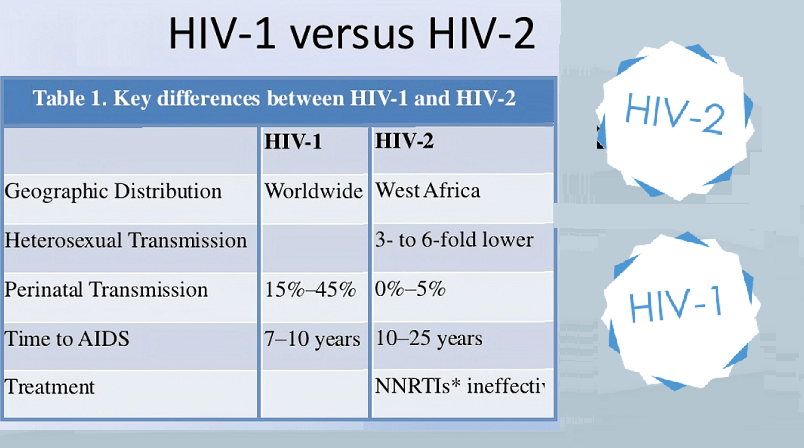
A. Mode of Transmission: Both types of HIV can be transmitted through blood, semen, vaginal fluid, and breast milk. HIV-1 is more easily transmitted through sexual contact compared to HIV-2.
B. Disease Progression: HIV-1 progresses more rapidly to AIDS compared to HIV-2, which has a slower progression.
C. Antibody Detection: Antibodies produced in response to HIV-1 and HIV-2 can be detected by tests. However, some tests may not accurately detect HIV-2.
D. Treatment and Medication: Both HIV-1 and HIV-2 are treatable. However, the medications used for treatment may differ between the two types.
| Differences | HIV-1 | HIV-2 |
|---|---|---|
| Origin Start Dicovered | West Africa First | West Africa Later |
| Transmission Sex Trans Mother to Baby | Sexual, blood-to-blood, mother-to-child Faster 15% – 45% | Sexual (less), blood-to-blood Slower (3 times) Less than 5% |
| Infectivity/Virulence Incubation | High 2 to 4 weeks | Low 2 to 4 weeks |
| Progression to AIDS | Faster 7-10 years | Slower 10-25 years |
| Tests Ab tests | ELISA, Western Blot Accurate | ELISA, Western Blot, Line Immunoassay Less accurate |
| Treatment | Antiretroviral therapy | Antiretroviral therapy |
| Prevalence | Global | Mainly in West Africa |
SUMMARY
Understanding the differences between HIV Types, (HIV-1 and HIV-2), is crucial for proper diagnosis and treatment. Early diagnosis and effective treatment, as well as prevention measures, are important in controlling the spread of HIV-2. This article provides a comprehensive overview of the key differences between the two types of HIV. It highlights the importance of addressing the issue of HIV-2. You may want to read our cornerstone article: Top HIV FAQs
SOURCES
- HIV (who.int)
- http://www.aidsmap.com
- http://www.avert.org/professionals
- http://cid.oxfordjournals.org/content/38/10/1447.full
Read More About HIV:
- HIV infection risk, who are the most vulnerable? Main ways of HIV infection.
- Sep 21, 2021
- HIV Western Blot Test: A Comprehensive Guidehiv-western-blot-test-a-comprehensive-guide. rapid HIV test. The test is also used to detect HIV infection. HIV Western Blot (HIV WB) is a very reliable and accurate diagnostic test.
- Mar 22, 2023
- HPV tests: A Guide to Screening and Preventionhpv-tests-a-guide-to-screening-and-prevention
- Jan 17, 2023
Do you have a question? please drop it down in the comments, or avail Online Medica Consultation; Click here for (FREE ONLINE CONSULTATION)
If you suspect that you may have symptoms, Helal Medical can help, offering quick, private, and convenient testing options. You may contact us here: Facebook page.
Discover more from Helal Medical Manila
Subscribe to get the latest posts sent to your email.


