
Semen Analysis Report Explained: How to Read!
Last Updated on 02/17/2026 by Helal Medical
Semen analysis report can help evaluate the fertility status of a man. It can also detect infection and confirm the success of a vasectomy operation. Male fertility can be assessed from the quantity and quality of sperm. Pus cells and red blood cells indicate infection in the male genital organs. Absence of sperm means success of vasectomy.
What if I told you this report isn’t a mystery? That you can understand it easily? This knowledge helps you take control. It helps you understand your fertility. Ready to decode your semen analysis?
In this article, we will break down a semen analysis report. We will explain key parameters. You will understand what they mean. This empowers you to discuss results. Discuss them with your doctor confidently. Read our cornerstone article (Semen Analysis Guide: Preparation, Results & Male Fertility).
How is semen analysis done?
To do semen test, you need to submit a sample of your semen to the laboratory. The result may be ready in about 4 hours after the semen sample is delivered to the laboratory.
How to collect the semen sample?
Semen can be collected at 2 sites. You can collect it at the laboratory itself or at home. Then deliver it to the laboratory within 30 to 60 minutes. Collecting the sample at the laboratory is preferred. This ensures quick submission without delay. Prompt submission is important to calculate the liquefaction time.
Semen analysis is an easy test. The results are delivered quickly. Therefore, it is usually the first to be requested for couples complaining of infertility or delayed pregnancy.
How useful is semen test?
Semen test report contains many useful data. It can help assess man’s infertility and health status. This includes: sample size, liquefaction time, pH value, and date collected by microscopic examination. Microscopically, we can know several aspects. These include the number of sperm, their shape, and motility. We also examine the presence of white blood cells in the sample.
Understanding Semen Analysis Report
When do you need a semen analysis?
If the couple stays together for more than one year without pregnancy, it is considered a case of infertility. In this case, the man should do the semen test.
The results will include the semen volume, sperm count, motility, and morphology. Other parameters are also assessed like semen volume, pH of the semen, and the presence of pus cells or any other findings. [2] If the results are average normal, then there is likely no issue with male fertility. However, if the results show abnormalities, further testing may be required to determine the underlying cause. [3] It is essential to discuss the results with your doctor to understand the implications and what your options are moving forward.
A normal sperm count ranges from 15 to 200 million sperm per milliliter of semen [1]. But if the sperm count is lower than 15 million per milliliter, it does not necessarily mean that a man is infertile. A man can still be fertile even with a low sperm count if the sperm quality is high. It must have a good shape, size, and swimming speed [2].
According to the World Health Organization (WHO), an ejaculate is considered normal if at least 1.5 mL, and it contains more than 15 million sperm per milliliter of semen. At least 32% should swim in a forward direction and at least 4% with normal shape [4].
Section 1: semen sample general information
The data in this section includes the following:
1- Period of abstinence from sexual intercourse. This may affect the number and quality of sperm. The ideal is no sex for 3 – 7 days.
2- Collection time. It is used to calculate the liquefaction time. It also helps calculate the percentage of motile sperm after one hour, 2 hours, then 3 hours.
3- Liquefaction time, The normal time ranges between 20-30 minutes after ejaculation. Some bacterial diseases (infection) in the testicle may cause prolonged liquefaction time.
Section 2: Physical Properties of the semen
- Appearance:
Greyish white is the normal color of semen. The color may change due to infection or presence pf red blood cells. - Sample volume – The healthy volume ranges between 2-6 ml. Infertility may occur because the sample size is small. The small size may be due to an infection or a varicocele.
- Acidity level (pH): Semen is normally alkaline, between 7.2-8 , which is contributed by prostatic secretions. Excessively low or high acidity can lead to the death of sperm cells or an imbalance in their movement.
- The color. the natural color is closer to light gray, and the color change indicates a problem. For example, a color close to red may indicate the presence of blood in the sample.
Section 3: Microscopic Examination
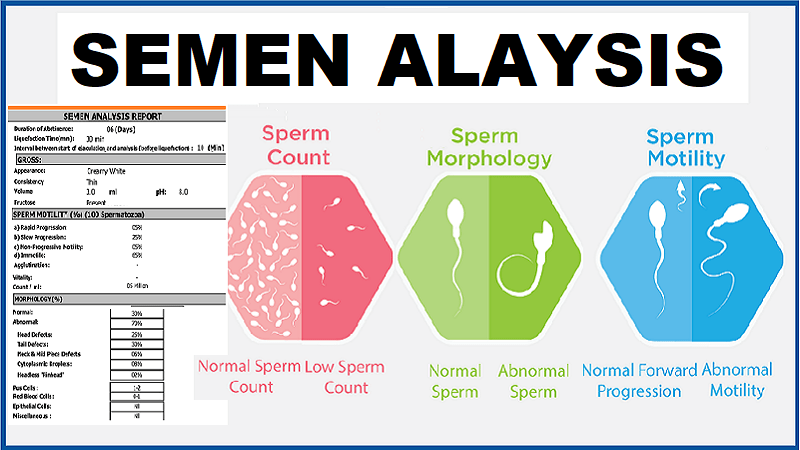
The microscopic examination is the most important part of the semen analysis report. It provides information on the quality and quantity of sperm. It also reveals the presence of any abnormal cells or substances. The following are the results of the microscopic examination:
A- Sperm Information
- Sperm count: Sperm count refers to the number of sperm present in the sample. It is expressed as the number of sperm per milliliter of semen. A normal sperm count is 40 million sperm or more in the sample. It can also be 15 million sperm per milliliter. A low sperm count can have several causes, including hormonal diseases, bacterial infections, chemical injury to the testicles, and others.
- Sperm motility: Sperm motility refers to the ability of sperm to move and swim. It is expressed as a percentage of the total number of sperm in the sample. The semen test report shows the percentage of motile sperm. It includes the percentage of sperm with fast forward movement, sperm moving slowly or in place, and immobile sperm.
- Sperm shape: The shape of the sperm is also evaluated as part of the semen analysis report. The percentage of sperm with normal shapes and abnormal shapes is determined. The location of the abnormality in the sperm shape is also noted. This includes the proportion of sperm with abnormal heads, necks, or tails.
B- Other Information
- White blood cells (pus cells): The presence of white blood cells in the semen is an indicator of infection. A normal semen sample should not contain white blood cells.
- Red blood cells: The number of red blood cells in the semen is also noted.
- Other findings in the sample: Any other findings in the semen sample are also recorded in the semen test report.
Related FAQs
- Q: What does it mean if my semen volume is low?
- A: Low semen volume may indicate dehydration, ejaculatory dysfunction, or a blockage in the reproductive tract.
- Q: What does it mean if my sperm motility is low?
- A: Low sperm motility can make it difficult for sperm to reach and fertilize the egg. It may be caused by various factors, including infection, varicocele, or lifestyle factors.
- Q: What does it mean if my sperm morphology is abnormal?
- A: Abnormal sperm morphology can reduce the sperm’s ability to penetrate the egg. However, even with abnormal morphology, fertilization is still possible.
SUMMARY
- Assessment of male fertility includes a physical examination, medical history and semen analysis. It may also include other tests such as scrotal ultrasound, hormone level blood tests, or genetic tests.
- Semen analysis helps determine fertility, detect infections, and assess the status of the testes.
- The test is recommended for men who have been trying to conceive for over a year. It is also advised for those with symptoms of infection, are anxious about their fertility, or have had a vasectomy.
- Key parameters evaluated include seminal fluid volume, sperm count, sperm morphology (shape), and sperm motility (movement).
- Normal sperm count ranges from 15 million to 200 million sperm per milliliter of semen.
- Sample collection requires abstaining from sexual activity for 2-5 days. Use a clean container. Deliver the sample to the lab within 60 minutes if collected at home.
- Samples can be collected through masturbation (preferably at the lab), using a condom during sex, or withdrawal before ejaculation.
SOURCES
- https://www.mayoclinic.org/diseases-conditions/low-sperm-count/diagnosis-treatment/drc-20374591
- https://www.healthline.com/health/semen-analysis
Do you have a question? please drop it down in the comments, or
Click here for (FREE ONLINE CONSULTATION)
If you suspect that you may have symptoms, Helal Medical can help, offering quick, private, and convenient testing options. You may contact us here: Facebook page.
Discover more from Helal Medical Manila
Subscribe to get the latest posts sent to your email.


