
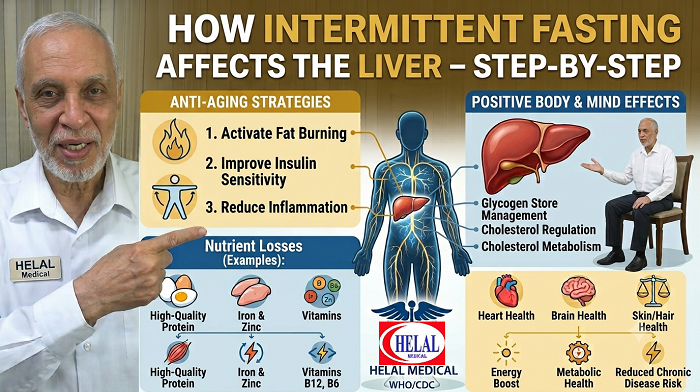
How Intermittent Fasting Affects the Liver: Step by Step
Intermittent fasting (IF) is more than just skipping meals, it completely switches how your liver works, burns energy, and repairs itself. Most people don’t realize that the liver is the organ most affected by fasting, and it goes through clear, predictable changes every time you enter a fasting window.
In this article, we will show is a simple, step-by-step breakdown of exactly what happens, from the first hour after eating to full metabolic reset, plus the long-term benefits.
What Intermittent Fasting Is
It’s an eating pattern that cycles between periods of eating and fasting, not about which foods to eat but when. It helps regulate metabolism, control blood sugar, and support weight management naturally.
Step 1: 0–4 Hours – The Fed State
Right after a meal, your blood sugar and insulin rise. The liver’s job is to store excess energy.
- Insulin signals the liver to turn glucose into glycogen and store it inside liver cells.
- Any extra sugar is converted into fat and stored as triglycerides.
- The liver is busy building, not burning—so fat burning is turned OFF.
- Common result: If you eat all day long, this state never ends, and fat slowly builds up in the liver.
Step 2: 4–12 Hours – Transition to Fasting
What happens: Blood sugar and insulin start dropping; glycogen stores begin to be used.
- Insulin falls, which removes the “stop signal” for fat burning.
- Liver starts breaking down its own glycogen to keep blood sugar stable.
- Once glycogen drops, the liver shifts from storing fat to releasing fat into the bloodstream.
- This means: Liver stops making new fat and starts preparing to burn stored fat.
Step 3: 12–16 Hours – Fat Burning Begins
What happens: Glycogen is nearly gone; the liver activates fat metabolism.
- Liver turns on PPAR-alpha, the master switch that breaks down fatty acids.
- Fatty acids travel from your body’s fat stores to the liver to be used as fuel.
- Ketogenesis starts:
Liver converts fat into ketone bodies which is clean fuel for your brain, muscles, and liver itself. - Insulin sensitivity improves.
Step 4: 16–24 Hours – Deep Clean & Repair
Maintenance mode: The liver’s “maintenance mode” kicks in.
- Autophagy activated:
This is the liver’s self-cleaning system; it breaks down old, damaged cells, toxic proteins, and excess fat droplets. - Inflammation drops sharply; liver enzymes (ALT/AST) start to fall.
- Liver stops making cholesterol and triglycerides; it focuses on clearing waste.
- For people with fatty liver, this is when visible fat reduction begins.
Step 5: 24–48+ Hours – Full Metabolic Reset
What happens: Maximum healing and fat removal.
- Almost all energy now comes from fat and ketones.
- Liver cells regenerate; scarring and early fibrosis may improve over time.
- Hormones like AMPK rise—supports insulin sensitivity and prevents new fat buildup.
- After repeating this cycle regularly, the liver becomes metabolically flexible: it easily switches between sugar and fat fuel.
Long-Term Effects of Intermittent Fasting on the Liver
When you practice intermittent fasting consistently for months and years, your liver doesn’t just work differently for a few hours—it actually changes for the better. Think of it like switching from always leaving your car engine running to giving it regular tune-ups: over time, it runs cleaner, lasts longer, and stays much healthier.
✅ 1. Burns Away Extra Liver Fat
What it means: Most people today have some fat stored inside their liver cells—this is called “fatty liver.” When you eat all day, your liver never gets a chance to use that fat. With regular fasting:
- Your liver slowly melts away stored fat, not just body fat
- Studies show it can reduce liver fat by 20% to 70% in 3–6 months
- It can even reverse early-stage fatty liver disease before it causes real damage
In short: Fasting turns your liver from a “fat storage tank” into a “fat-burning machine.”
✅ 2. Fixes Insulin Resistance (The Root Problem)
High sugar and constant eating make your liver “numb” to insulin—this is called insulin resistance. This is the #1 reason fat builds up in the liver and leads to diabetes.
- Over time, fasting makes your liver sensitive to insulin again
- It stops forcing your liver to turn every extra bite into fat
- Blood sugar and insulin levels stay stable, not spiking all day
✅ 3. Reduces Inflammation & Repairs Damage
When fat piles up, it causes swelling and inflammation inside the liver—like a bruise that never heals.
- Fasting activates autophagy—the liver’s built-in “self-cleaning system”
- It clears out old, damaged cells, toxins, and excess fat
- Liver enzymes (ALT/AST) go back to normal, meaning less stress and injury
- Over years, it can slow or stop early scarring (fibrosis) from getting worse
✅ 4. Prevents Serious Liver Disease
What it means: If left unchecked, fatty liver can turn into severe inflammation, scarring, cirrhosis, or even raise cancer risk.
- Long-term fasting stops this chain reaction
- It lowers risk of NASH (fatty liver with inflammation) and cirrhosis
- It keeps your liver flexible and able to do its 500+ jobs: filtering blood, making bile, storing vitamins, and clearing toxins
✅ 5. Better Metabolic Flexibility
What it means:
A healthy liver can switch easily between using sugar when you eat and fat when you fast.
This means more steady energy, less bloating, and better digestion overall
After months of fasting, your liver becomes “metabolically flexible”
It never gets overloaded, even if you eat a larger meal sometimes
TABLE: How Intermittent Fasting Affects the Liver: Step by Step
| Fasting Stage | Timeframe | Main Liver Action | Key Benefit |
|---|---|---|---|
| Fed | 0–4 hr | Store glucose & fat | Energy reserve |
| Early Fast | 4–12 hr | Burn glycogen, lower insulin | Prepare for fat use |
| Fat Burn | 12–16 hr | Break down fat, make ketones | Reduce liver fat |
| Deep Clean | 16–24 hr | Autophagy, repair cells | Remove toxins & damage |
| Reset | 24+ hr | Full fat metabolism, regeneration | Long-term liver health |
Important Notes
- Best for: People with fatty liver, insulin resistance, or metabolic syndrome.
- Caution: Not for those with severe liver disease, cirrhosis, or eating disorders—always consult a doctor first.
- Works best with: Lower sugar/refined carbs during eating windows.
Trusted Sources
- National Library of Medicine (PMC): Impact of Intermittent Fasting on NAFLDhttps://pmc.ncbi.nlm.nih.gov/articles/PMC10564080/
- Harvard Health: Intermittent Fasting and Metabolic Healthhttps://www.health.harvard.edu/blog/intermittent-fasting-surprising-update-2018062914156
- World Journal of Gastroenterology: Mechanisms of Fasting in Liver Diseasehttps://www.wjgnet.com/1007-9327/full/v29/i25/4024.htm
🔗 Connect with Helal Medical:
If you suspect that you may have symptoms, Helal Medical can help, offering quick, private, and convenient testing options. You may contact us here: Facebook page, Get Free medical consultation!
This article provides general information. Always consult with a healthcare professional for personalized medical advice.
Discover more from Helal Medical Manila
Subscribe to get the latest posts sent to your email.


