
Beyond Germs: Understanding What Actually Causes Infectious Diseases
Last Updated on 08/28/2026 by DrHelal, MD Medical Doctor with 50+ Years of Clinical Practice • [Read Full Author Bio & Credentials →]
Have you ever wondered why some people catch a cold easily while others stay healthy? Or how a simple mosquito bite can lead to serious illness?
The answer lies in understanding infectious diseases causes. It’s far more than just “being around germs.” Keep reading, and you’ll learn exactly what triggers infections, how they spread, and why knowing this keeps you and your family safe.
When we hear the word “infection,” we usually think of bacteria or viruses. But causes of infectious diseases cover a whole range of microscopic organisms, plus how they enter our bodies and multiply.
In this article, we will break the subjects it down in simple language; no complicated medical jargon — so you can clearly understand what’s really going on.
What Exactly Are Infectious Diseases?
An infectious disease is any illness caused by tiny living things that invade your body, multiply, and damage your cells or tissues. Unlike non-infectious conditions like diabetes or heart disease, these illnesses can spread from one person to another, or from animals, food, water, or insects to humans.
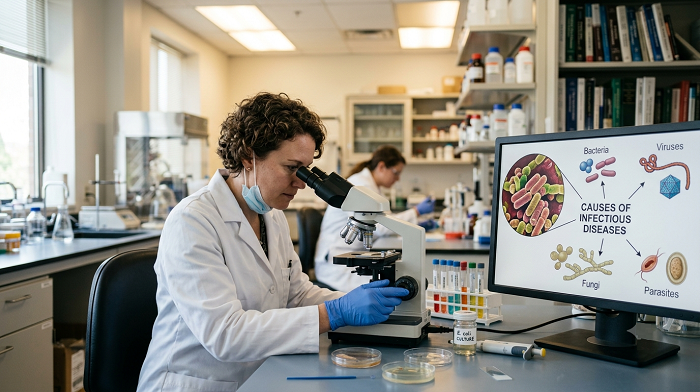
To understand infectious diseases causes, we first need to meet the main types of pathogens — the “germs” that start it all.
Main Types of Pathogens: The Root Causes
Bacteria
These are single-celled organisms found everywhere — in soil, water, food, and even on your skin. Most bacteria are harmless or helpful; only a small number cause disease. Examples: Strep throat, tuberculosis, and urinary tract infections.
Viruses
Much smaller than bacteria, viruses need to live inside human or animal cells to survive and multiply. They hijack your cells to make more copies of themselves. Common examples: flu, COVID-19, dengue, and measles.
Fungi
These include yeasts and molds. They thrive in warm, damp places. Infections often affect the skin, nails, or lungs. Examples: athlete’s foot, ringworm, and yeast infections.
Parasites
Organisms that live on or inside another living thing (host) and feed off it. They can spread through contaminated food, water, or insect bites. Examples: malaria, intestinal worms, and giardia.
Prions
Rare but serious — abnormal proteins that trigger normal proteins in the brain to fold incorrectly. These cause very rare, degenerative brain diseases.
How Do Infections Enter & Spread?
Knowing the source is only half the story. For infectious diseases causes to lead to illness, germs must get inside your body. Here are the most common ways:
Direct Contact
- Person-to-person: Touching, shaking hands, kissing, or sexual contact.
- Animal-to-person: Bites or scratches from infected pets or wildlife, or handling animal waste.
Indirect Contact
Germs linger on surfaces like doorknobs, phones, tables, or towels. When you touch them and then touch your face, mouth, or eyes, you become infected.
Airborne & Droplet Spread
When someone coughs, sneezes, talks, or breathes, tiny droplets or particles float in the air. You breathe them in, and the infection enters your lungs.
Food & Waterborne
Eating raw/undercooked food, drinking unclean water, or consuming food handled by someone sick can bring germs straight into your digestive system — causing diarrhea, vomiting, or fever.
Vector-Borne
Carried by insects like mosquitoes, ticks, and flies. When they bite, they pass the germ from one host to another. This is very common in tropical regions like the Philippines — think dengue, malaria, and Zika.
Why Do Some People Get Sick While Others Don’t?
Here’s a key fact: not every germ makes you sick. Several factors decide whether exposure turns into an infection:
- Strength of your immune system: If your defenses are strong, they often kill germs before they multiply.
- Amount of germs: A small number may be destroyed quickly; a large load can overwhelm your body.
- Type of germ: Some are much more aggressive than others.
- Your overall health: Chronic illness, stress, lack of sleep, or poor nutrition lowers your protection.
Quick Overview: Causes & Transmission
Table
| Pathogen Type | Common Examples | Main Route of Spread |
|---|---|---|
| Bacteria | Strep throat, TB, food poisoning | Contact, food/water, air |
| Virus | Flu, COVID-19, dengue | Air, droplets, mosquitoes, contact |
| Fungus | Ringworm, athlete’s foot | Skin contact, damp surfaces |
| Parasite | Malaria, worms | Insect bites, food/water |
| Prion | Rare brain diseases | Infected tissue/genetic |
Summary
Understanding infectious diseases causes means recognizing that illness starts with specific germs — bacteria, viruses, fungi, parasites, or prions — that enter the body through contact, air, food, water, or insects. The good news? Once you know how they work, you can take simple steps to lower your risk. This knowledge is the foundation for recognizing symptoms, choosing the right treatment, and stopping the spread before it starts.
Trusted Sources for More Information
- World Health Organization (WHO): Infectious Diseases Overview
- Centers for Disease Control and Prevention (CDC): Understanding Infectious Diseases
- Department of Health Philippines: Common Infectious Diseases
🔗 Connect with Helal Medical:
If you suspect that you may have symptoms, Helal Medical can help, offering quick, private, and convenient testing options. You may contact us here: Facebook page, Get Free medical consultation!
This article provides general information. Always consult with a healthcare professional for personalized medical advice.
Discover more from Helal Medical Manila
Subscribe to get the latest posts sent to your email.


