
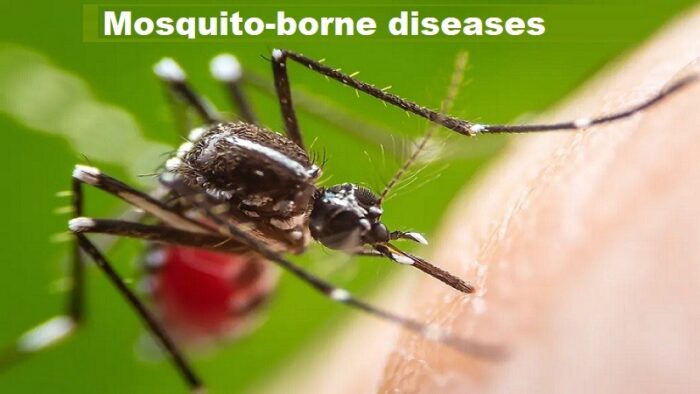
Mosquito-borne diseases Common Types
Last Updated on 09/10/2026 by DrHelal, MD Medical Doctor with 50+ Years of Clinical Practice • [Read Full Author Bio & Credentials →]
Diseases that are spread from mosquito to human are known as a mosquito-borne diseases. How? When a mosquito bites a human to suck blood for feeding, it also sucks any viruses or parasites living in that blood. These viruses and parasites can be transferred to other persons the mosquito bites. Pathogens are transferred through the saliva of the mosquito causing infections, which are classified as infectious or communicable diseases.
Mosquito-borne diseases set to flourish in warmer climes
A mosquito bite can infect you with deadly diseases.
Is Mosquito an Animal or an Insect?
They are considered both: Mosquito is under phylum Arthropoda > class Insecta, which is the largest class in Arthropoda. Mosquitos are also classified animals, as they have no capacity to produce food on their own. Thus, Mosquitoes are one of the smallest animals on Earth, yet they are the deadliest creatures in the whole world.
Common types of mosquito-borne diseases
While the mosquito may not be affected by pathogens sucked with blood, mosquito-borne diseases can cause severe disease for the infected person. Around 400 million people are infected each year with dengue, and another hundreds of thousands are infected by Zika, chikungunya and yellow fever. Most common types of mosquito-borne diseases include malaria, dengue, chikungunya, yellow fever and Zika.

1- Zika Fever (mosquito-borne disease)
Many adults with Zika virus have no symptoms, but the infection can be severe for the unborn baby.
Zika fever is one of the mosquito-borne diseases. Causative pathogen is Zika virus. Symptoms look like dengue fever, but many patients don’t show symptoms. Common symptoms include fever, red eyes, joint pain, headache and a maculopapular rash. Children for infected women by Zika virus, can have serious health conditions, including microcephaly, which can cause life-long disabilities.
Common symptoms of Zika Fever
| Fever | Rash | Red eyes (Conjunctivitis) | Headache | Muscle and joint pain |

2- Dengue fever
Dengue fever is another mosquito-borne disease, where the cause is dengue virus.
Incubation period: Symptoms typically begin 3 to 14 days after infection. Commonly, infected persons present with fever, rash, nausea pains. If no complications developed, symptoms last a week. Otherwise, it may progress to complications such as internal bleeding, shock and even death, a situation that requires hospitalization.
Prevalence: Recently, the incidence of dengue has increased dramatically. More than half of the world’s population now at risk, with approximately 36,000 people die from dengue fever, every year.
Common symptoms of Dengue fever
| Fever | Rash | Headache | Vomiting | Muscle and joint pain |
3- Yellow fever, a deadly Mosquito-borne disease
When mosquito bites people, not many develop yellow fever, but some may develop a severe illness and die within 7 to 10 days.
Yellow fever is another mosquito-borne disease, which is a viral disease of short duration. Yellow fever is an acute viral hemorrhagic disease.
Causative pathogen: caused by flavivirus. yellow fever spreads through bites by infected aedes aegypti mosquitoes, which breed in tropical forests, still water and in humid weather.
Symptoms: In most cases, symptoms include fever, chills, loss of appetite, nausea, muscle pains (back pain) and headaches. Symptoms tend to improve within five days, however approximately 30,000 people around the world die from yellow fever every year.
Common symptoms of yellow fever
- Fever
- Headache
- Chills
- Back pain
- Fatigue
- Vomiting
4- Chikungunya
Chikungunya is a viral disease transmitted to humans via infected Aedes aegypti mosquitoes.
Symptoms include fever, joint pain, headache, muscle pain, joint swelling and rash. In most cases, a patient’s condition will improve within a week, however the joint pain may last for months or even years in some persons. Chikungunya shares some clinical signs with Zika and dengue, leading to potential misdiagnosis.
Common symptoms of Chikungunya
- Sudden fever
- Joint and muscle pain
- Rash
- Headache
- Fatigue
5- Malaria
- Malaria is transmitted through mosquito bites. It is caused by parasites in the genus Plasmodium. In humans, malaria is caused by six Plasmodium species: P. falciparum, P. malariae, P. ovale curtisi, P. ovale wallikeri, P. vivax and P. knowlesi.
- Malaria is treatable in few weeks but may be dangerous and last for several months.
- For diagnosis, lab tests may be required.
- Symptoms include fever, tiredness, vomiting, and headaches. In severe cases, it can cause jaundice, seizures, coma, or death.
Symptoms usually begin 10-15 days after infection.
The Silent Global Threat
The scale of the crisis is staggering. Mosquito-borne diseases cause over 700,000 deaths annually and infect billions worldwide. The sheer volume of cases strains healthcare systems, impedes economic development, and leaves a trail of debilitating, long-term health issues in its wake.
1. Dengue: The Breakbone Epidemic
Of the various viral and parasitic diseases transmitted by mosquitoes, Dengue fever is one of the most rapidly spreading. Endemic in over 100 countries, it accounts for up to 390 million infections each year. The virus, transmitted by the highly adaptable Aedes aegypti and Aedes albopictus mosquitoes, is often referred to as “breakbone fever” due to the excruciating joint and muscle pain it causes.
While many cases are mild, a significant percentage can progress to severe dengue (formerly known as dengue hemorrhagic fever or dengue shock syndrome), which can be fatal without intensive medical management. The recurring, cyclical nature of dengue epidemics, particularly during the rainy season, keeps countless communities in a state of perpetual risk.
2. Malaria: The Parasitic Killer
While massive global efforts have reduced its incidence, Malaria remains a catastrophic parasitic disease, primarily transmitted by the Anopheles mosquito. It is responsible for hundreds of thousands of deaths annually, disproportionately affecting children under five in sub-Saharan Africa. The constant evolution of drug-resistant parasite strains and insecticide-resistant mosquitoes presents a major challenge to the goal of global eradication.
3. Emerging and Re-emerging Threats
Beyond the two major killers, other mosquito-borne diseases like Chikungunya and Zika are constantly spreading to new geographies. Chikungunya, also carried by Aedes species, causes debilitating and long-lasting joint pain. Zika, while often asymptomatic, is notorious for its link to severe birth defects, such as microcephaly, when a pregnant mother is infected. The global risk mapping for these diseases is continually being redrawn, often expanding into new areas as climate change creates more favorable conditions for mosquito habitats at higher altitudes and latitudes.
The Local Challenge in Manila, Philippines
For us here in the Philippines, the threat of mosquito-borne diseases is ever-present. Our tropical climate, characterized by warmth, humidity, and abundant rainfall, is an ideal breeding ground for the Aedes and Culex mosquitoes that carry Dengue, Chikungunya, and Japanese Encephalitis.
Dengue fever is arguably the most significant public health threat in Manila and the surrounding metropolitan area. Densely populated urban centers, where sanitation and stagnant water management are constant struggles, provide the perfect habitat for the “cockroach of mosquitoes,” Aedes aegypti, which thrives in human-made containers.
While malaria risk is generally lower in the densely urbanized Metro Manila area, it remains a concern in certain rural and forested parts of the country. Japanese Encephalitis (JE), transmitted by Culex mosquitoes, is also endemic, posing a risk of severe neurological complications, especially to children. This local reality underscores the essential need for readily accessible, high-quality medical services that can quickly diagnose and effectively manage these complex infections.
Helal Medical: Your Frontline Defense in Manila
At Helal Medical in Manila, Philippines, we are committed to being your most trusted partner in the fight against mosquito-borne diseases. We provide the diagnostic clarity and proactive health services that save lives.
Essential Services We Provide:
1. Rapid & Accurate Diagnostics: Early detection is crucial, especially for severe dengue. We offer advanced laboratory testing to quickly confirm infections like Dengue, Malaria, and other viral fevers. Rapid, precise diagnosis allows for the immediate initiation of supportive care, which is the cornerstone of preventing progression to life-threatening complications.
2. Expert Medical Consultation: Our physicians are experienced in the clinical management of tropical diseases, including crucial fluid management and patient monitoring required for severe cases of Dengue.
3. Proactive Prevention Advice: We provide personalized advice on vector control, protective measures, and, where available and appropriate, guidance on travel-related vaccines and prophylactic medications.
SOURCES:
- What are mosquito-borne diseases?
- Is A Mosquito An Animal Or An Insect? Classification Guide
💬 Chat with Us:
You can easily reach Helal Medical via WhatsApp (+63 966 974 1609), Facebook Messenger, or by clicking the chat icon at the lower right corner of our website HelalMedical.com.
Read more from helalmedical.com:
1. W.I.L.D diseaeses during the rainy season in the Philippines?
2. Dengue fever during the rainy season protecting your family in the Philippines
3. Health risks during floods in the philippines and how to stay safe
4. Diseases and conditions / STDs / HIV / Men’s health / Healthy lifestyle
5. Common Bacterial Infections in the Philippines: Your Health Guide
6. Safe from 5 common Infections During Rainy Season in the Philippines
7. Respiratory Infections During Flood Season: How to Protect Your Lungs
Discover more from Helal Medical Manila
Subscribe to get the latest posts sent to your email.


